

In-Depth Pangasius Analysis: Price Trends Late 2026 Into 2027
Pangasius price forecast 2026-2027: fillet scenarios $2.70-$4.20/kg. Mekong supply, duties, targets.
The pangasius price forecast 2026 2027 points to a balanced market with policy-driven tails: we estimate export-grade frozen fillet FOB Vietnam near 3.30 dollars per kilogram in late 2026, with early-2027 outcomes spanning 2.70 to 4.20 dollars per kilogram across bear, base, and bull cases (all figures are estimates).
What follows examines foodservice demand and feed economics, Mekong supply and frozen-stock balances, duty and inspection risks, and three probability-weighted pangasius scenarios.
Macro Backdrop: Foodservice Demand, Whitefish Substitution, and the Dollar
Our pangasius price forecast 2026 2027 starts on dinner plates rather than in ponds, because frozen fillet demand from foodservice distributors and retail buyers sets the pace that Mekong Delta farmers follow with a lag of several months. By late 2026 United States policy rates near 3.50 percent to 3.75 percent (estimate) have steadied restaurant traffic and grocery spending after the affordability squeeze of prior years, supporting orders for value-priced whitefish portions. The Federal Reserve policy record frames that backdrop (see federalreserve.gov). Pangasius competes directly with tilapia, pollock, and cod in breaded and battered applications, so every dollar of movement in wild-caught whitefish prices reprices farmed fillets within a single buying season.
European demand provides the second leg. Euro-area buyers absorbed steady volumes of frozen pangasius fillets through 2026 as cod quotas tightened and hake prices stayed firm, keeping Vietnamese offers competitive on a per-kilo basis even after freight. World output growth near 3 percent, per the International Monetary Fund outlook (see imf.org/WEO), underwrites household protein spending across the Middle East, Latin America, and Southeast Asia, where pangasius has expanded well beyond its traditional markets. Chinese buying adds a volatile swing factor: inspectors alternate between rapid clearance and detailed residue checks, and a single regulatory pause can strand containers and force distressed resale into secondary markets.
The dollar index near 98 to 100 (estimate) keeps dollar-quoted fillet offers affordable for euro- and real-denominated buyers while preserving dong-reporting processor margins on export contracts. Feed costs matter more than currency, though, because feed represents roughly 70 percent of farm production cost (estimate), tying pond economics to soybean meal and fishmeal markets. The Food and Agriculture Organization tracks the fishmeal and aquaculture linkage in its market reviews (see FAO fisheries statistics). When feed prices fall while fillet quotes hold, farmers rush to stock fingerlings, sowing the oversupply that depresses prices two harvest cycles later.
Supply and Demand: Mekong Ponds, Processing Lines, and Frozen Stocks
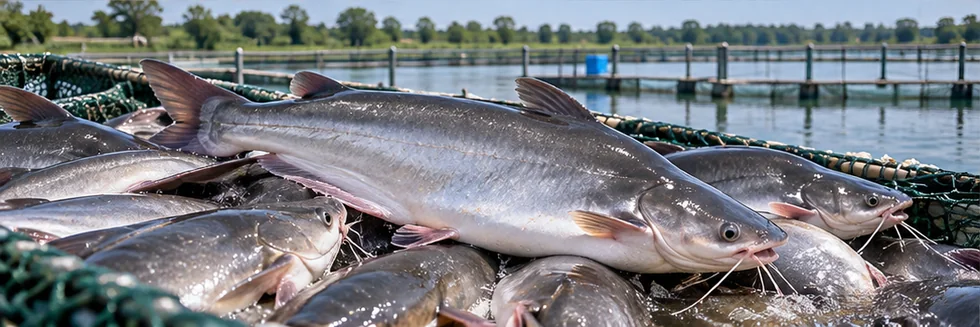
Farm supply centers on the Mekong Delta provinces of Dong Thap, An Giang, and Can Tho, where pond area and stocking density adjust quickly to price signals. Our estimate puts 2026 Vietnamese pangasius harvest near 1.7 million tonnes live weight (estimate), modestly above 2025, with processing yields near 35 percent into fillets. Hatchery output of fingerlings ran strong through the first half of 2026, encouraged by farmgate prices that covered feed plus a margin, which points to ample raw fish availability into early 2027. Disease pressure from bacterial infections trimmed survival rates on some farms, but aeration upgrades and vaccination adoption limited losses compared with earlier outbreak years.
Processing capacity shapes the exportable surplus. Plants around Chau Doc and Can Tho run filleting, glazing, and freezing lines that convert harvest peaks into exportable frozen blocks within days, and cold-storage stocks in Ho Chi Minh City and Haiphong buffer shipment timing. Our late-2026 assessment centers export-grade frozen fillet FOB Ho Chi Minh City near 3.30 dollars per kilogram (estimate), with United States wholesale fillets near 3.60 dollars and European import values near 2.80 euros equivalent. Farmgate raw fish traded near 29,000 Vietnamese dong per kilogram (estimate), comfortably above estimated cash costs near 24,000 dong, so farmers have limited incentive to cut stocking.
| Pangasius market gauge | Late-2026 reading | Signal for 2027 |
|---|---|---|
| Frozen fillet FOB Vietnam | $3.30/kg (estimate) | Mid-range; stocks set direction |
| Farmgate raw fish | VND 29,000/kg (estimate) | Above cash cost; stocking steady |
| US wholesale fillet | $3.60/kg (estimate) | Menu demand holds the floor |
| Feed share of farm cost | Near 70 percent (estimate) | Soymeal moves lead margins |
| Annual harvest | 1.7 million tonnes (estimate) | Ample raw fish into early 2027 |
Demand absorbs supply through three channels with different rhythms. United States breaded-portion packers buy steadily on quarterly programs, European retailers promote pangasius during Lenten and summer grilling seasons, and Chinese traders buy opportunistically in bulk when domestic freshwater fish prices spike. Certification splits the market: Aquaculture Stewardship Council and Best Aquaculture Practices labels command premiums of 10 to 20 cents per kilogram (estimate) from European and North American retailers, while uncertified fish clears faster into price-sensitive Middle Eastern and Latin American outlets. Substitution caps rallies: whenever fillet offers push above about 3.80 dollars per kilogram (estimate), portion makers reformulate toward tilapia or pollock, trimming pangasius call within weeks.
Inventories complete the balance. United States cold-storage holdings of imported whitefish entering winter sit near average (estimate), pointing to routine first-quarter restocking rather than panic buying. Vietnamese processors typically build stocks ahead of Tet holidays when pond harvesting pauses, and the size of that build determines spot availability in February and March. Buyers who track weekly container bookings out of Cat Lai port get the earliest read on whether processors are long or short, since booking volumes anticipate fillet price moves by several weeks. The World Bank commodity program offers cross-commodity context on food-price trends alongside these flows (see World Bank commodity markets).
Geopolitics and Trade Policy: Duties, Inspections, and Freight Lanes
United States antidumping reviews remain the sharpest policy risk. The Commerce Department periodic reviews of the pangasius order assign company-specific duty rates that can range from low single digits to prohibitive levels, and each preliminary determination reprices affected exporters shipments for months. Exporters with low individual rates gain share rapidly, while high-rate producers divert tons to Europe, China, and emerging markets, depressing prices there. Any widening of the order or new countervailing-duty petitions in 2027 would lift compliant-origin premiums ahead of benchmark quotes.
Chinese inspection policy is the second swing factor. Residue testing for veterinary drugs and glazing-ratio verification periodically slows clearance at border gates and seaports, forcing sellers to discount delayed lots or reroute them. When inspections run smoothly, Chinese demand absorbs lower-grade and smaller-size fillets that Western retailers reject, firming the whole size curve. European market access depends on residue-control compliance and processing-plant listings, which Vietnam maintains through national monitoring programs, but a single rapid-alert notification can pause individual plant shipments for weeks.
Freight and currency frictions add episodic noise. Reefer container rates from Vietnam to the United States East Coast and to Rotterdam oscillated through 2026 on Red Sea routing choices, adding 10 to 25 cents per kilogram (estimate) during disrupted stretches. None of these frictions changes annual balances, yet each can spike regional wholesale prices during narrow promotional windows when portion makers cannot defer coverage. Buyers should therefore qualify suppliers across at least two Vietnamese processors plus one alternative whitefish origin, since single-origin coverage leaves programs exposed to duty rulings and inspection pauses alike.
Scenario Outlook and Price Targets for Early 2027
We center export-grade frozen pangasius fillet FOB Vietnam near 3.45 dollars per kilogram in early 2027 (estimate), with a bear case at 2.70 and a bull case at 4.20. The base path assumes steady United States foodservice buying, normal Chinese clearance, no new duty shocks, and farmgate prices that keep ponds stocked without flooding the market. European promotions clear harvest-peak volumes, and feed costs stay contained, preserving farmer margins at current stocking rates.
Bear conditions combine a bumper harvest with a United States demand pause or an adverse duty ruling that diverts tons into distressed resale, pushing FOB toward 2.70 dollars near processor cash costs. Bull conditions need synchronized Chinese restocking plus a residue-related supply squeeze or freight disruption during peak promotion season, forcing portion makers to chase fillets toward 4.20 dollars. Portion makers should extend coverage on dips below 3.00 dollars, while farmers should lock feed and stagger stocking rather than expanding pond area into strength above 3.60 dollars where substitution risk rises sharply.
In-Depth Pangasius Analysis: Price Trends Late 2026 Into 2027 — FAQ
Which pangasius price should buyers track into 2027?
Use export-grade frozen fillet FOB Ho Chi Minh City near 3.30 dollars per kilogram as the world anchor in late 2026, then adjust for destination: United States wholesale runs near 3.60 dollars and European imports near 2.80 euros equivalent. Farmgate raw fish near 29,000 dong per kilogram sets the upstream floor, and certified product adds 10 to 20 cents per kilogram.
How should portion makers manage pangasius exposure for 2027?
Spread quarterly programs across at least two Vietnamese processors, keep four to six weeks of frozen cover ahead of Tet and Lent promotions, and hold an approved tilapia or pollock alternative for reformulation. Avoid fixing full-year volumes during duty-review announcements, when quotes overshoot before settling.
Does tilapia or pollock competition cap pangasius prices?
Only at the margin through 2027, since China-origin tilapia faces its own tariff and inspection frictions while pollock supply depends on wild quotas. Pangasius keeps its cost edge in breaded applications, though sustained prices above 3.80 dollars per kilogram would invite reformulation away from it.
Sources & references: Federal Reserve - Monetary Policy IMF World Economic Outlook FAO Fisheries Statistics World Bank Commodity Markets