


Understanding Steel billets Prices
Market Overview & Supply Chain Dynamics
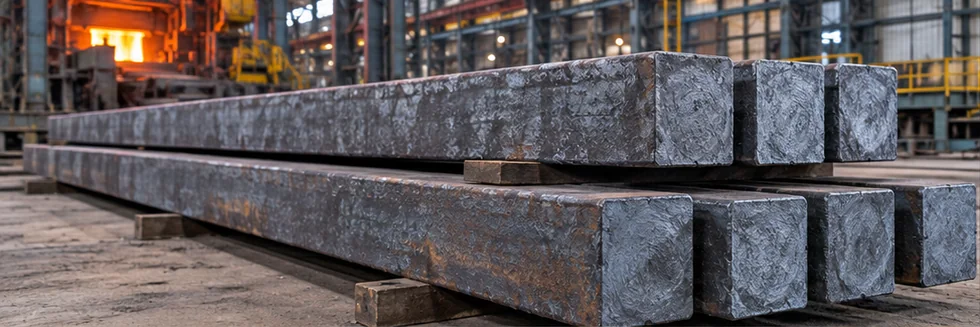
Steel Billets are semi-finished products made by continuous casting or other casting routes. Cross-section, carbon grade, surface defects, and internal soundness determine their downstream value. Billets for long products are not equivalent to flat slabs, and a commodity rebar billet may not meet a quality-wire or forging specification. Merchant supply depends on melt-shop output, caster schedules, and whether mills consume billets internally.
Key Applications & Industrial Demand
Rebar, wire rod, merchant bars, and selected forged products begin from suitable billets. Rolling mills buy sections compatible with their furnaces and equipment. Chemistry, dimensional tolerance, and surface quality help determine achievable yield and the range of finished products.
Key Factors Influencing Steel Billets Price Movements
- Steelmaking Charge Costs: Scrap, DRI, pig iron, ore-based hot metal, energy, and caster utilization influence the cost of producing exportable billets.
- Cast Quality: Continuous casting controls, carbon grade, and surface defects affect rolling performance and the risk of flaws appearing in finished long products.
- Rolling Compatibility: Cross-section, length, and demand from long products mills determine which billets can be used without costly handling or reheating adjustments.
How to Interpret Steel Billets Pricing Data
Billet quotations commonly use metric tons with a stated grade, section, length, and delivery term. A finished-rebar value includes rolling and cannot substitute directly. Mill certificates, casting quality, reheating needs, and transport all affect a reroller's effective cost.
Further reading: World Steel Association: Steel Production and Products
Frequently Asked Questions About Steel billets
What Drives Price Changes for Steel Billets?
Steelmaking inputs, billet exports, reroller margins, and construction-related long-product demand move prices. Merchant supply changes when integrated mills retain more cast steel for their own rolling.
How Do Quality or Specification Differences Affect Steel Billets Pricing?
Chemistry, section tolerance, surface cracks, internal soundness, and length distinguish billets. Higher-quality wire or forging applications may require tighter controls than basic construction steel.
Why Can Local Steel Billets Prices Differ From Global Benchmarks?
Port costs, import duty, inland haulage, furnace compatibility, and local rerolling demand influence values. Restrictions on accepted origins or grades can further limit a mill's options.