


Understanding POM Prices
Market Overview & Supply Chain Dynamics
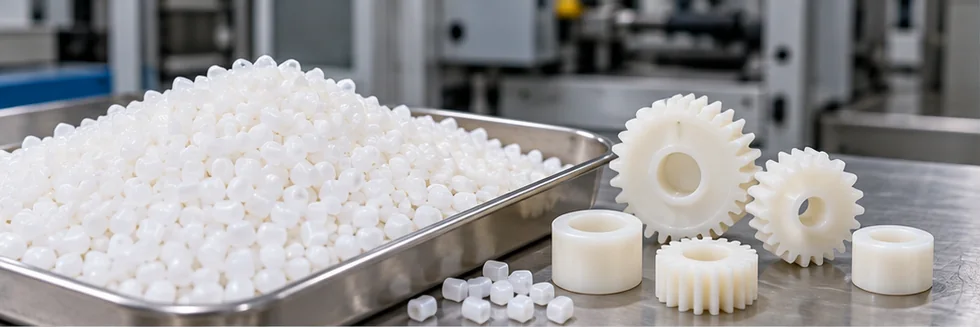
POM is an acetal polymer valued for low friction, wear resistance, and dimensional stability. Homopolymer and copolymer families differ in processing and performance, while lubricated or reinforced compounds add further distinctions. Producers polymerize and stabilize the resin for controlled molding behavior. Buyers of precision components therefore assess grade identity, flow, thermal stability, and additive package instead of treating all acetal pellets as identical.
Key Applications & Industrial Demand
Gears, bearings, fasteners, appliance mechanisms, automotive parts, and fluid-handling components use POM. Its ability to retain dimensions and slide against other surfaces supports metal replacement in selected mechanisms. Potable-water, food-contact, and emissions-sensitive applications can require specifically qualified grades.
Key Factors Influencing POM Price Movements
- Polymer Family: Homopolymer and copolymer supply chains differ, while an established customer may require the precise acetal polymer family already qualified in its mechanism.
- Tribological Performance: Low friction and wear resistance can require lubricants or specialized compounds, creating premiums for parts subjected to sustained sliding or repeated motion.
- Precision Manufacturing: Dimensional stability, melt consistency, and processing cleanliness affect tight-tolerance molding, so reject rates can outweigh modest savings on general-purpose resin.
How to Interpret POM Pricing Data
POM resin offers generally use kilograms or metric tons. Compare homopolymer and copolymer separately, with flow, lubricants, color, and approvals specified. Finished rods and machined parts include extrusion, machining, and yield costs that a pellet benchmark excludes.
Further reading: BASF Engineering Plastics and POM
Frequently Asked Questions About POM
What drives price changes for POM?
Feedstock economics, acetal-plant availability, vehicle production, and precision-component demand influence prices. Specialty low-friction or approved grades can carry separate premiums.
How do quality or specification differences affect POM pricing?
Polymer family, melt flow, wear additives, reinforcement, color, and application approvals determine value. A lubricated gear compound differs from ordinary unfilled molding resin.
Why can local POM prices differ from global benchmarks?
Regional approved stocks, compounding, import duty, freight, and technical support affect local cost. Engineering customers often pay for reliable grade continuity and small-lot availability.